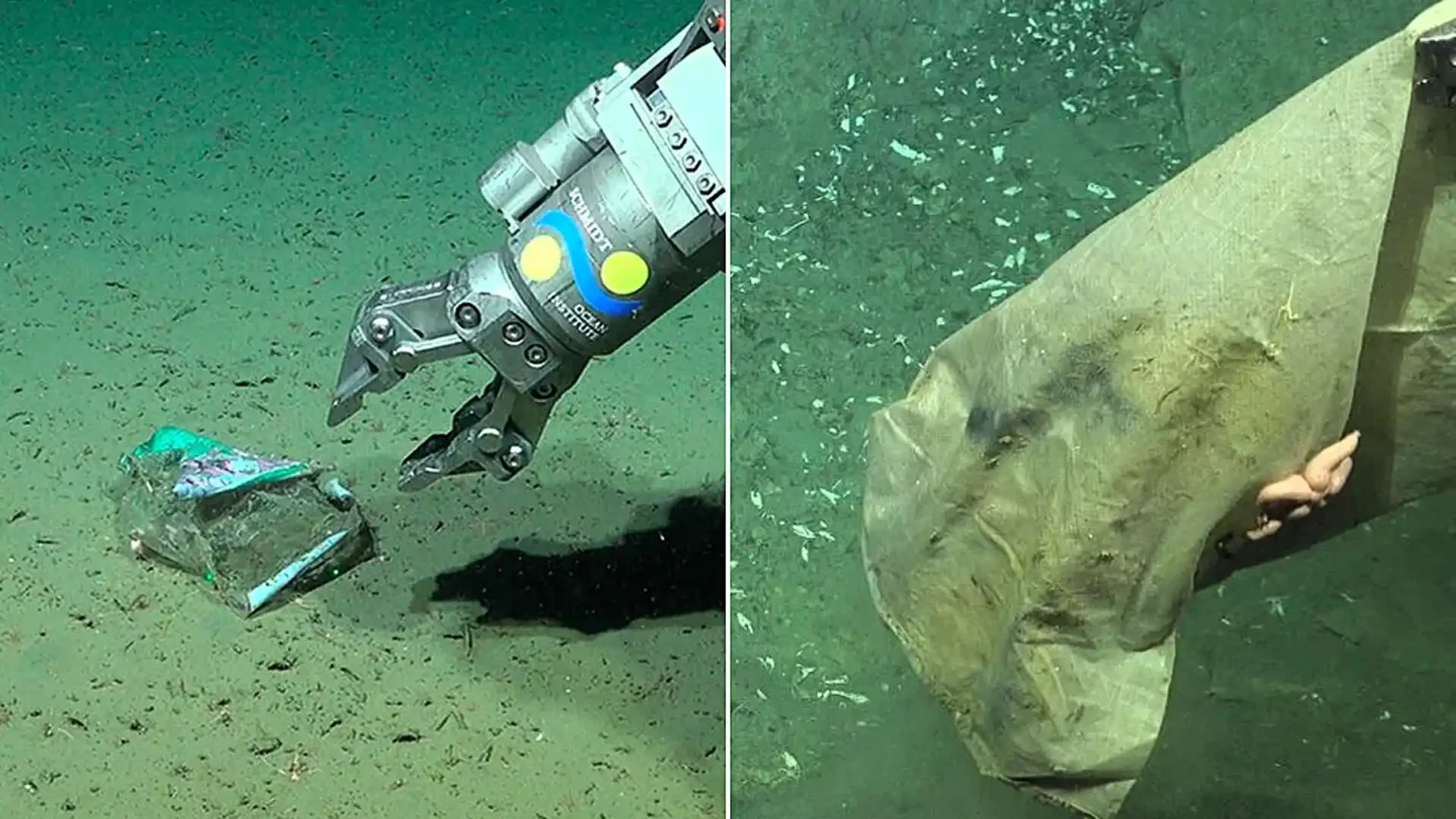
Examples of deep-sea litter found in the Mar del Plata Submarine Canyon. (H) Nylon cord with a hook (S0825 - event 29), 1,949 m. (Jam Press/Schmidt Ocean Institute/ROV SuBastian (CC BY 4.0), expedition FKt250712/Teso et al., 2026, PLOS One, CC-BY 4.0)
Scientists exploring a supposedly pristine deep-sea canyon have discovered a shocking collection of human rubbish lurking thousands of metres below the waves.
Researchers found plastic bags, food wrappers, fishing gear – and even a rubber boot – scattered across the floor of the Mar del Plata Submarine Canyon, around 250km off the coast of Argentina.
The team made the discovery during 17 dives using a remotely operated submersible in July and August 2025.
They documented 29 pieces of man-made litter at depths of between 1,120m and 3,820m.
Plastic accounted for 27 of the items, while the other two were made of rubber.
Some rubbish was buried in the sediment, while other pieces were trapped between rocks or drifting close to the seabed.
One boot, made in Argentina, was found at a depth of around 2,047m, as reported by What’s The Jam.
Examples of deep-sea litter found in the Mar del Plata Submarine Canyon. (B) Rubber boot (S0816 – event 14), 2,598 m. (Jam Press/Schmidt Ocean Institute/ROV SuBastian (CC BY 4.0), expedition FKt250712/Teso et al., 2026, PLOS One, CC-BY 4.0)
Deep-sea researcher Daniel Lauretta said: “For me the most striking individual piece of litter was a single boot, lying on the seafloor.”
The scientists believe much of the rubbish was likely dumped or lost by vessels operating offshore, particularly fishing boats.
The canyon is detached from the land and sits more than 250km offshore, making it unlikely that most of the debris came directly from coastal towns.
The researchers also found deep-sea creatures living on or around seven pieces of rubbish.
Starfish, crustaceans, corals and other organisms were seen interacting with plastic and fishing gear.
Examples of deep-sea litter found in the Mar del Plata Submarine Canyon. (F) Sediment-filled plastic bag (S0820 – event 23), 3,739 m. (Jam Press/Schmidt Ocean Institute/ROV SuBastian (CC BY 4.0), expedition FKt250712/Teso et al., 2026, PLOS One, CC-BY 4.0)
But the scientists warned this does not mean the rubbish is beneficial to marine life.
Instead, plastic and other debris can act as artificial surfaces that alter deep-sea habitats and potentially allow organisms to spread beyond their normal range.
Diego Urteaga, another member of the research team, said the findings were a reminder of how far human rubbish can travel.
He said: “We may already be altering deep-sea communities that we have barely begun to understand.”
The study, published in PLOS One, is the first to document marine litter in the Mar del Plata Submarine Canyon.
The team also noted that the amount of rubbish found was relatively low compared with other submarine canyons around the world.
But its presence at depths of almost 4,000m shows that even some of the most remote corners of the planet are not untouched by human activity.
Examples of deep-sea litter found in the Mar del Plata Submarine Canyon. (A) Medium-sized plastic wrapper, 2,109 m. (B) Rubber boot, 2,598 m. (C) Food wrapper, 1,920 m. (D) Snack wrapper, 3,231 m. (E) Tissue paper wrapper, 3,814 m. (F) Sediment-filled plastic bag, 3,739 m. (G) Highly degraded plastic fragment, 3,709 m. (H) Nylon cord with a hook, 1,949 m. (I) White plastic cup and bag (arrows), 3,243 m. Scale bars: 10 cm. (Jam Press/Schmidt Ocean Institute/ROV SuBastian (CC BY 4.0), expedition FKt250712/Teso et al., 2026, PLOS One, CC-BY 4.0)Faunal interactions with anthropogenic litter in the Mar del Plata Submarine Canyon (MPSC). (A) Degraded black plastic sheet, partially buried, with arthropods including Tetrachaelasma southwardi and an octocoral, 2,108 m. (B) Plastic bag with the asteroid Smilasterias sp., 3,243 m. (C) Fishing rope with tubicolous polychaetes, 2,054 m. (D) Nylon filament (probably fishing line) with Anthozoa polyp indet., 1,616 m. (E) White plastic container, partially buried, with the brittle star Ophioplinthus sp. and probable ascidian, 1,764 m. (Jam Press/Schmidt Ocean Institute/ROV SuBastian (CC BY 4.0), expedition FKt250712/Teso et al., 2026, PLOS One, CC-BY 4.0)Examples of deep-sea litter found in the Mar del Plata Submarine Canyon. (H) Nylon cord with a hook (S0825 – event 29), 1,949 m. (Jam Press/Schmidt Ocean Institute/ROV SuBastian (CC BY 4.0), expedition FKt250712/Teso et al., 2026, PLOS One, CC-BY 4.0)Examples of deep-sea litter found in the Mar del Plata Submarine Canyon. (C) Food wrapper (S0816 – event 12), 1,920 m. (Jam Press/Schmidt Ocean Institute/ROV SuBastian (CC BY 4.0), expedition FKt250712/Teso et al., 2026, PLOS One, CC-BY 4.0)Examples of deep-sea litter found in the Mar del Plata Submarine Canyon. (I) White plastic cup and bag (arrows) (S0819 – items 17-18), 3,243 m. Scale bars: 10 cm. (Jam Press/Schmidt Ocean Institute/ROV SuBastian (CC BY 4.0), expedition FKt250712/Teso et al., 2026, PLOS One, CC-BY 4.0)