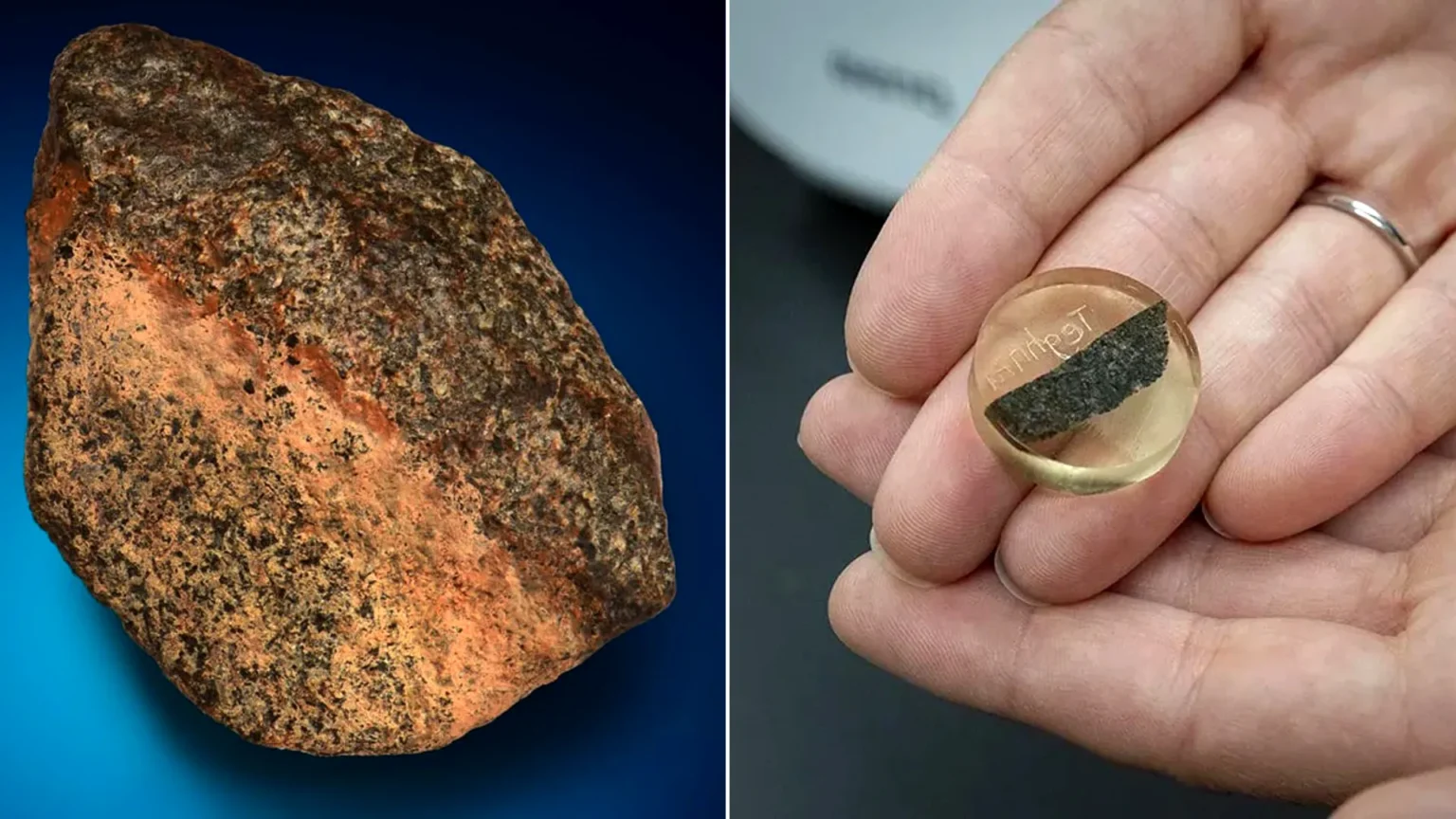
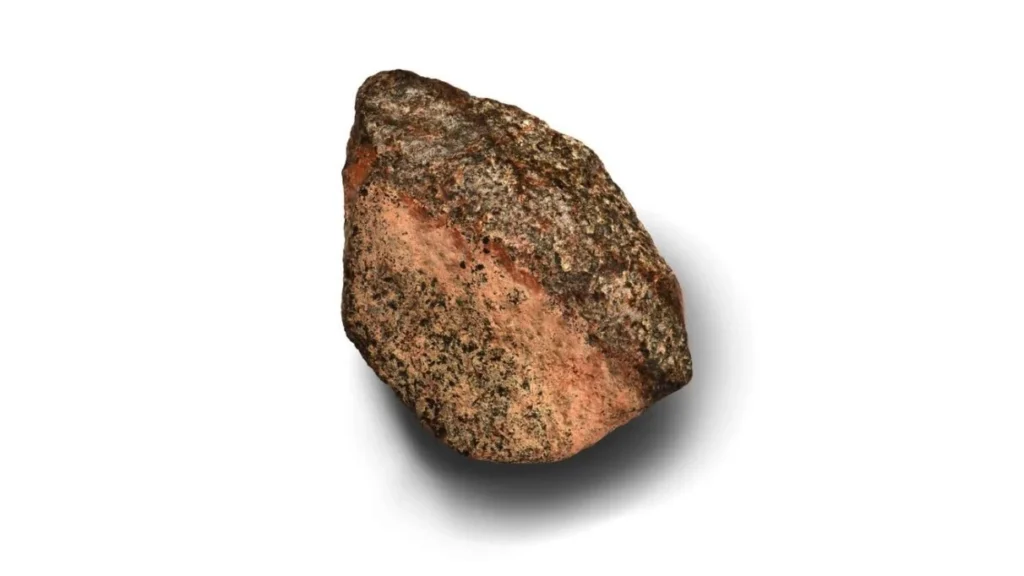
The pink rock discovered, named as Teghaza 001. (Jam Press/Darryl Pitt/Maine Mineral & Gem Museum)
SHARE
The rosy-coloured stone, weighing almost 2lbs, was found in the desert before scientists discovered it was one of the oldest Martian meteorites ever identified on Earth.
Named Teghaza 001, after the salt plain in Mali where it was discovered, the space rock offers a rare glimpse into what the Red Planet was like billions of years ago.
Researchers estimate it formed more than 4.1 billion years ago, making it one of just three of the most ancient Martian meteorites found on Earth, as reported by What’s The Jam.
The findings were published in the journal Science on 29 October, following analysis of the rock’s minerals and chemical composition.
Scientists discovered that Teghaza 001 was originally formed from cooling magma, which eventually became part of Mars’ outer crust.
The pink rock discovered, named as Teghaza 001. (Jam Press/Darryl Pitt/Maine Mineral & Gem Museum)
But the rock also contains evidence that it was later altered by water beneath the planet’s surface.
The discovery adds to growing evidence that Mars was once a much wetter world than the dry, dusty planet we know today.
And that could have significant implications for the search for signs of ancient life.
- Advertisement -
Water is considered a key ingredient for life as we know it, and researchers say the meteorite provides further evidence that early Mars may have had the conditions needed to support living organisms.
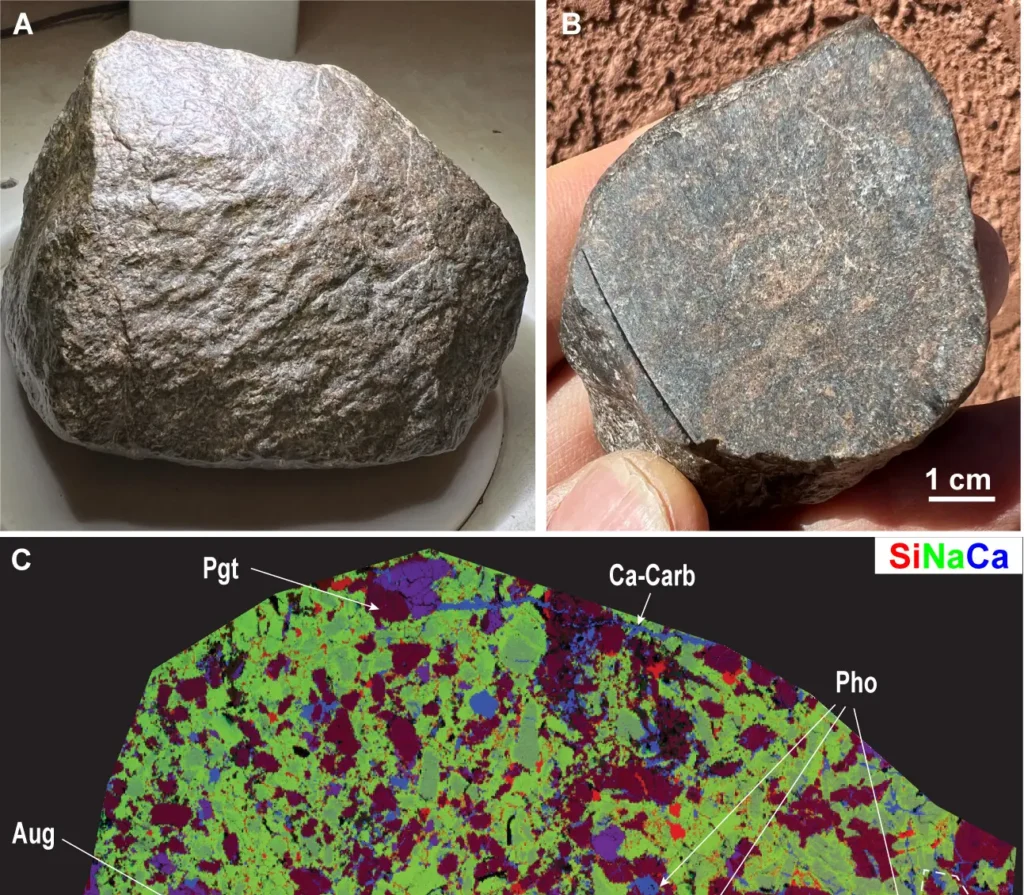
(The dashed white contour encloses an area rich in large ilmenite grains and mesostasis, consisting of elongated K-rich glass in a Si-rich matrix (fig. S4). (Jam Press/Caltech)
However, the discovery does not prove that life ever existed on the planet.
The meteorite is particularly valuable because it gives scientists a new sample of ancient Martian crust to study.
- Advertisement -
NASA researcher Yang Liu, the lead author of the study, said one reviewer had described it as a “Rosetta Stone for Mars”.
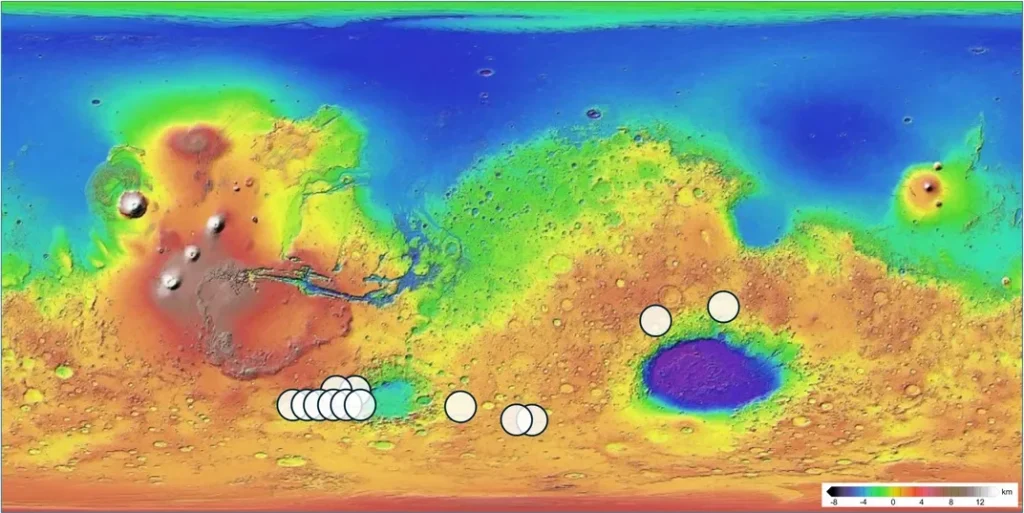
Scientists believe the rock may have originated in the planet’s southern highlands, although its exact birthplace remains unknown.
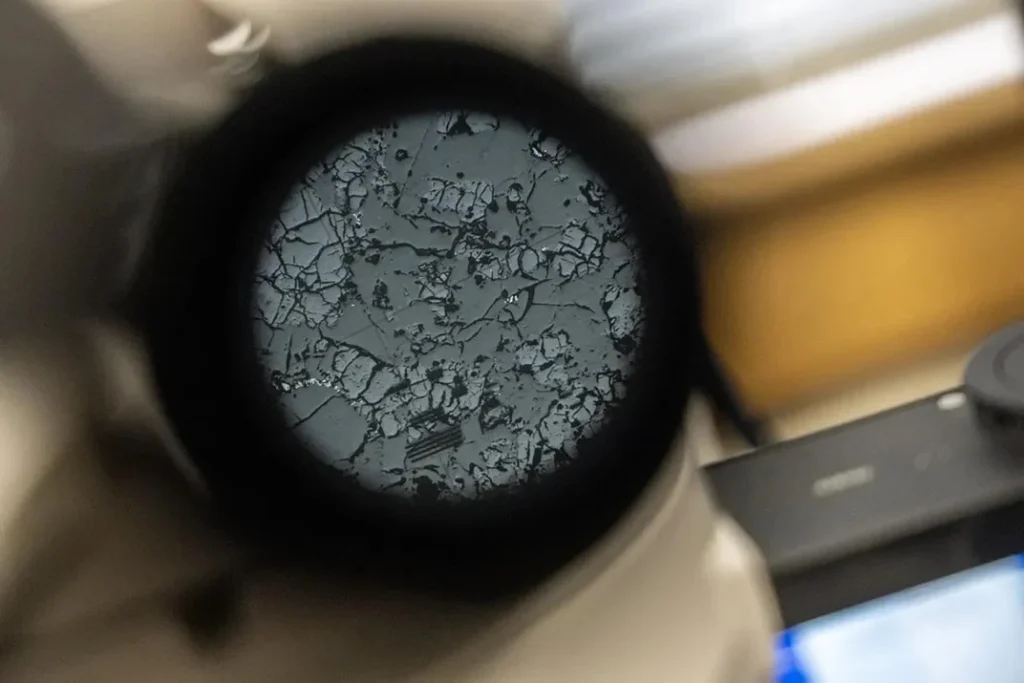
A sample of Teghaza 001 seen through a microscope. (Jam Press/University of Maine)
They have identified 13 possible locations on Mars whose mineral and chemical make-up matches the meteorite.
Martian meteorites are formed when huge impacts blast pieces of rock off the planet’s surface and send them hurtling through space.
Some eventually travel through Earth’s atmosphere and land on our planet.
Thirteen locations on Mars where Teghaza 001 may have come from. (Jam Press/NASA/JPL-Caltech/USGS)
More than 400 Martian meteorites have been identified, but samples this ancient are extremely rare.
Researchers hope further examination of Teghaza 001 will help them understand how Mars’ crust formed and how water interacted with the planet in its earliest days.
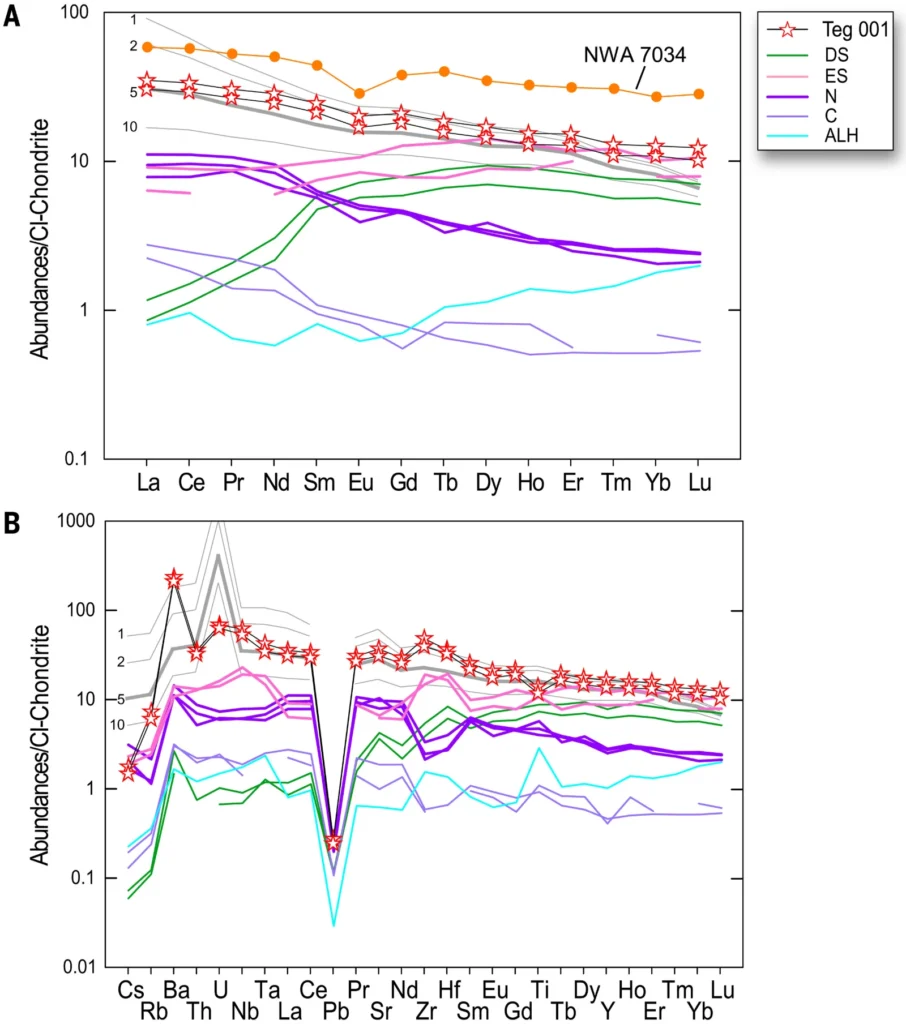
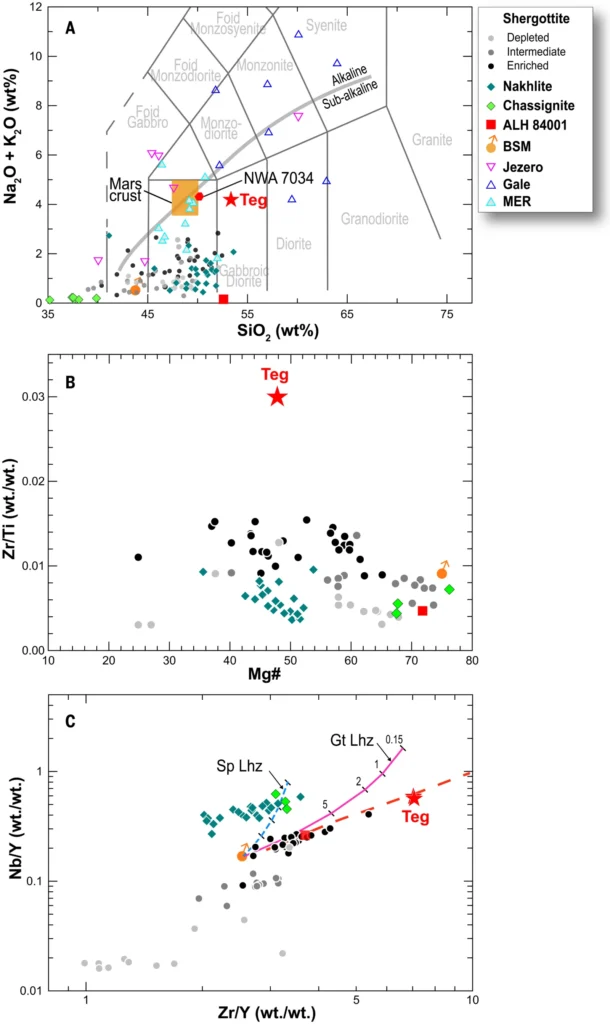
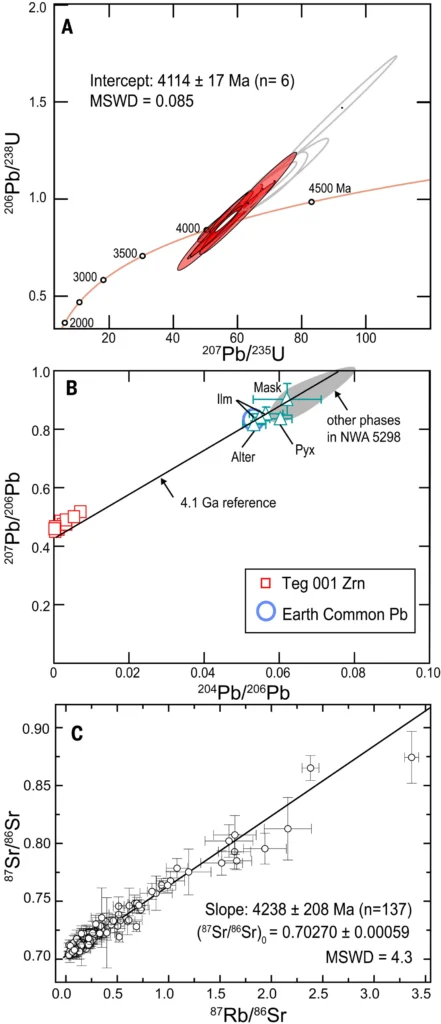
Elemental abundances of (A) rare earth elements and (B) other trace elements, in decreasing order of their tendency to remain in the melt during crystallization. All measurements have been normalized to CI chondrites . Missing values were below the detection limit or not analyzed in previous studies. Red stars connected by thin black lines are two different analyses for Teg 001 . Gray lines are theoretical calculations for partial melting of garnet lherzolite, starting from bulk silicate Mars composition; each line shows a different degree of partial melting, labelled in percent . Colored lines show other Martian meteorites : the depleted shergottite Tissint (green); the enriched shergottites Shergotty and Zagami (both pink); the nakhlite Nakhla (thick purple); the chassignite Chassigny (thin lilac); and ALH 84001 (cyan). (Jam Press/Caltech)(A) Rock classification using Na2O + K2O content as a function of SiO2. Data for other Mars samples and Teg 001 (red star) have been renormalized so the elemental oxides add to 100%. Thin gray lines are compositional boundaries of different rock types . The thick gray curve is the boundary between alkaline and subalkaline rocks . Other Martian meteorites: ALH 84001 (red square), chassignites (green diamonds), nakhlites (teal diamonds) and shergottites (black and gray circles) . For shergottites, we follow a previous classification as depleted (light gray), intermediate (mid gray), or enriched (black). The gold Mars symbol indicates bulk silicate Mars (BSM) . Also shown are rocks measured by rovers: cyan triangles by the Mars Exploration Rovers (MER), blue upward triangles by the Curiosity rover in Gale crater, and pink downward triangles by the Perseverance rover in Jezero crater . Symbols are the same in all panels. (B) Zr/Ti weight ratio as a function of magnesium abundance Mg#. (C) The ratio Nb/Y as a function of Zr/Y. Colored lines show our calculations for fractional partial melting of a mantle rock (lherzolite, lhz) containing spinel (Sp, blue) or garnet (Gt, pink), and previous calculations of fractional melting of a mantle containing garnet . Tick marks and numbers indicate the degree of melting in percent. (Jam Press/Caltech)(A) Results for the U-Pb chronometer. The orange curve shows the expected 206Pb/238U and 207Pb/235U values (concordant curve) for samples with the labelled formation ages (in Ma). Gray ellipses show the 2σ uncertainty regions for our ten measurements of six zircon grains (data S2). Six measurements (pink shading) intersect the concordant curve, at a mean age of 4114 ± 17 Ma. Four measurements (empty ellipses) lie above the concordant curve (so are reverse discordant), indicating either imperfect matrix correction, the addition of non-radiogenic Pb, or the loss of U. Also labelled are the mean square weighted deviation (MSWD), and number of measurements used (n) to derive the age and MSWD. (B) Results for the Pb-Pb chronometer. Data points are raw 207Pb/206Pb and 204Pb/206Pb ratios of zircons (red squares) and other phases (cyan triangles labelled mineral phases). The blue circle shows the Earth Pb isotopes used for common lead correction. The gray shaded region encompasses silicates and Fe-Ti oxides in NWA 5298 . The black line is a reference trend at 4.1 Ga . Error bars show 2 s.e., except when smaller than the symbol size or when uncertainties were not reported by previous studies. (C) Results for the Rb-Sr chronometer. Data points are in-situ measurements; their error bars show 2 s.e. from Poisson statistics. The black line is an isochron fitted to the data, which has age 4238 ± 208 Ma and initial Sr/Sr = 0.70270 ± 0.00059. (Jam Press/Caltech)