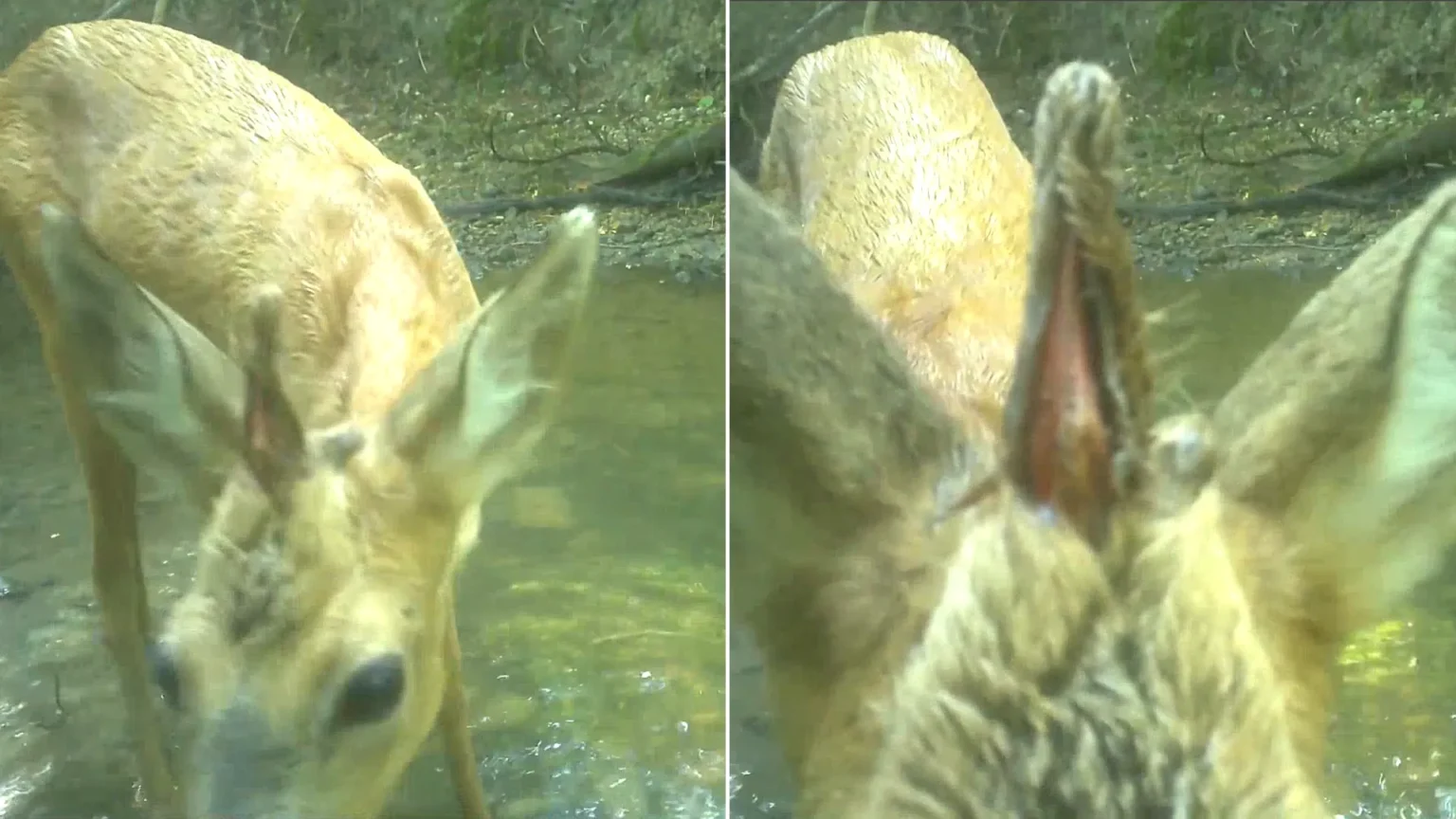

A real-life ‘unicorn’ has been caught on camera wandering through a forest, leaving viewers baffled by the mysterious horn-like growth sprouting from the middle of its head.
As the animal turned towards the lens, a single narrow projection could be seen jutting out from the centre of its forehead, giving it an uncanny resemblance to the mythical creature.
In the clip, the deer splashes through the water and takes a drink before pushing its face right up to the camera, giving a close-up view of the strange appendage. It then wanders out of shot.
READ MORE: UPDATE: Eyewitness claims ‘crying child’ threw hat that killed Fiona the hippo
Experts say it is impossible to tell exactly what the growth is from the footage alone, as reported by What’s The Jam.
Male roe deer usually grow two short antlers from separate bony bases on the skull, known as pedicles, but the unusual projection sits much closer to the centre of the forehead.
Injuries to the pedicles or to the growing antler tissue can cause antlers to develop in unusual shapes or in odd positions on the head.
Unlike horns, antlers are made of bone and are shed and regrown every year.
Roe deer bucks normally cast their antlers in late autumn or early winter and regrow them over the colder months. The new antlers are covered in a soft, blood-rich skin known as velvet, which the animals rub off in spring.
Roe deer are one of the most widespread deer species in Europe. They are relatively small, with a reddish-brown coat in summer that turns greyish-brown in winter.
The roe deer was filmed by a hidden wildlife camera on Saaremaa, Estonia’s largest island, as it waded into a shallow stream to drink.
The animal on Saaremaa has not been examined, and no measurements of the growth have been taken.
The footage was shared on Facebook by the Lutreola Foundation, the conservation group that runs the camera, and was reported by Estonian media last Tuesday (17 Nov).
The camera had been set up to monitor the endangered European mink, which the Lutreola Foundation is working to establish on the island.
The European mink is one of Europe’s most threatened mammals and is listed as critically endangered. It has disappeared from most of its former range, with competition from the invasive American mink among the threats it faces.
The same camera also captured footage of a rare black stork, a secretive bird that nests deep in the forest and is far more reclusive than its familiar white cousin.
Black storks breed in Europe during the warmer months before migrating south, with most spending the winter in Africa.
The foundation was founded in 1992 and officially established in 1999. It takes its name from the European mink’s Latin name, Mustela lutreola, and has also worked to protect the freshwater pearl mussel and the Siberian flying squirrel.
READ MORE: Zookeeper insists nothing could have saved hippo from her tragic death after eating knitted hat