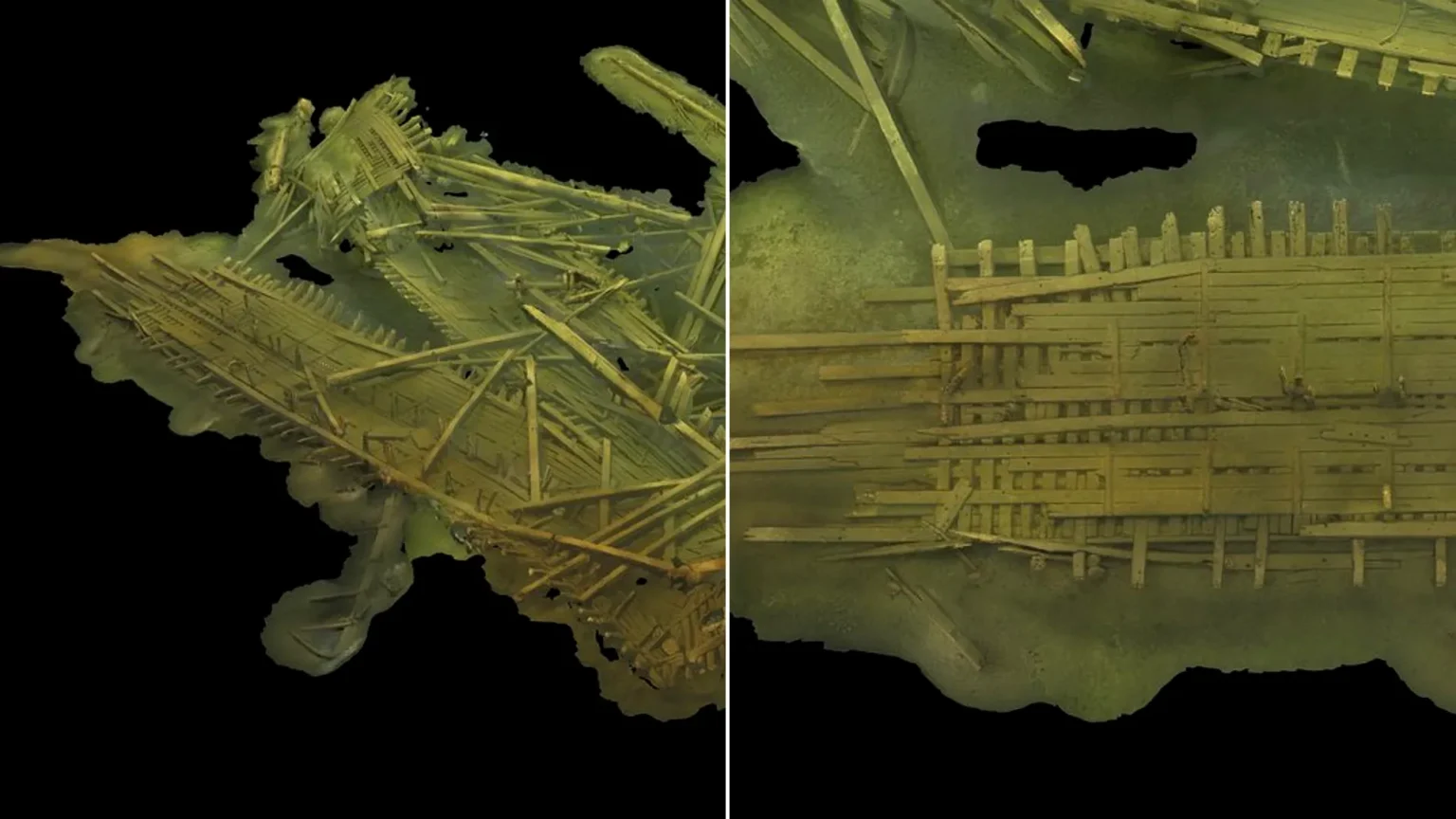


A mystery British shipwreck lying on the Baltic seabed has finally been identified 161 years after it sank.
The wooden vessel has been confirmed as the Bedford, a full-rigged clipper built in Sunderland and launched in January 1864.
The approximately 140ft-long ship survived for less than two years before capsizing during a violent storm in October 1865.
READ MORE: Collector sets world record opening £7,000 cards on wing of FLYING PLANE
It was carrying 6,000 sacks of rye flour from St Petersburg towards the Amur River in Russia’s Far East when it struck a shoal near Rönnskär, Finland, as reported by What’s The Jam.
All 19 crew members were rescued by Finnish pilots, who braved worsening weather to reach the stricken sailors.


Some of the Bedford’s cargo was also recovered, but the ship drifted towards Inkoo before becoming lodged on an underwater islet and sinking.
Its wreckage has remained on the north-eastern slope of the Suparbådarna shoal ever since, approximately 25 metres – or 82ft – beneath the surface.
Despite the disaster being widely reported by Finnish newspapers at the time, the wreck’s precise resting place and identity were not confirmed for more than a century-and-a-half.
The breakthrough came after Sami Brchisky, a specialist researcher at the Finnish Heritage Agency, reviewed reports of unusual objects spotted underwater.


Marine archaeologists confirmed the site using side-scan sonar before completing two inspection dives.
Divers photographed the shattered wreck for a photogrammetric survey, allowing expert Kari Hyttinen to create a detailed 3D model of the vessel and take precise measurements.
The team also noticed several unusual construction features, including iron supports where wooden ones would normally be expected.
Two fastening bolts were recovered for X-ray fluorescence testing, which revealed they were made from brass rather than iron.


Brass only became widely used in shipbuilding from the 1840s, helping researchers narrow down the vessel’s age and search more recent shipping archives.
Documents in Lloyd’s Register revealed a remarkable series of matches with the Bedford.
Its position, hull shape and measurements corresponded with the records, as did its copper-plated bottom, iron knees, brass fastenings and onboard winch.
The latter was particularly distinctive because the Bedford used a winch to handle its rigging instead of the capstan more commonly installed on ships of the period.

The Bedford had been built from oak by Sunderland shipbuilder John Davidson, who produced 28 vessels during his career.
It was the largest ship he had completed at the time and made its maiden voyage to Hong Kong.
Clippers were designed to carry goods quickly between Europe and the Far East, particularly valuable cargoes such as tea.

Before their arrival, journeys around the Cape of Good Hope could take between four and six months.
The fastest clippers cut that voyage to around 100 days, but their dominance was later ended by steamships and the opening of the Suez Canal in 1869.
The newly identified Bedford is now protected as part of Finland’s underwater cultural heritage.
READ MORE: Cadbury brings back limited-edition Twirl flavour as shoppers cheer