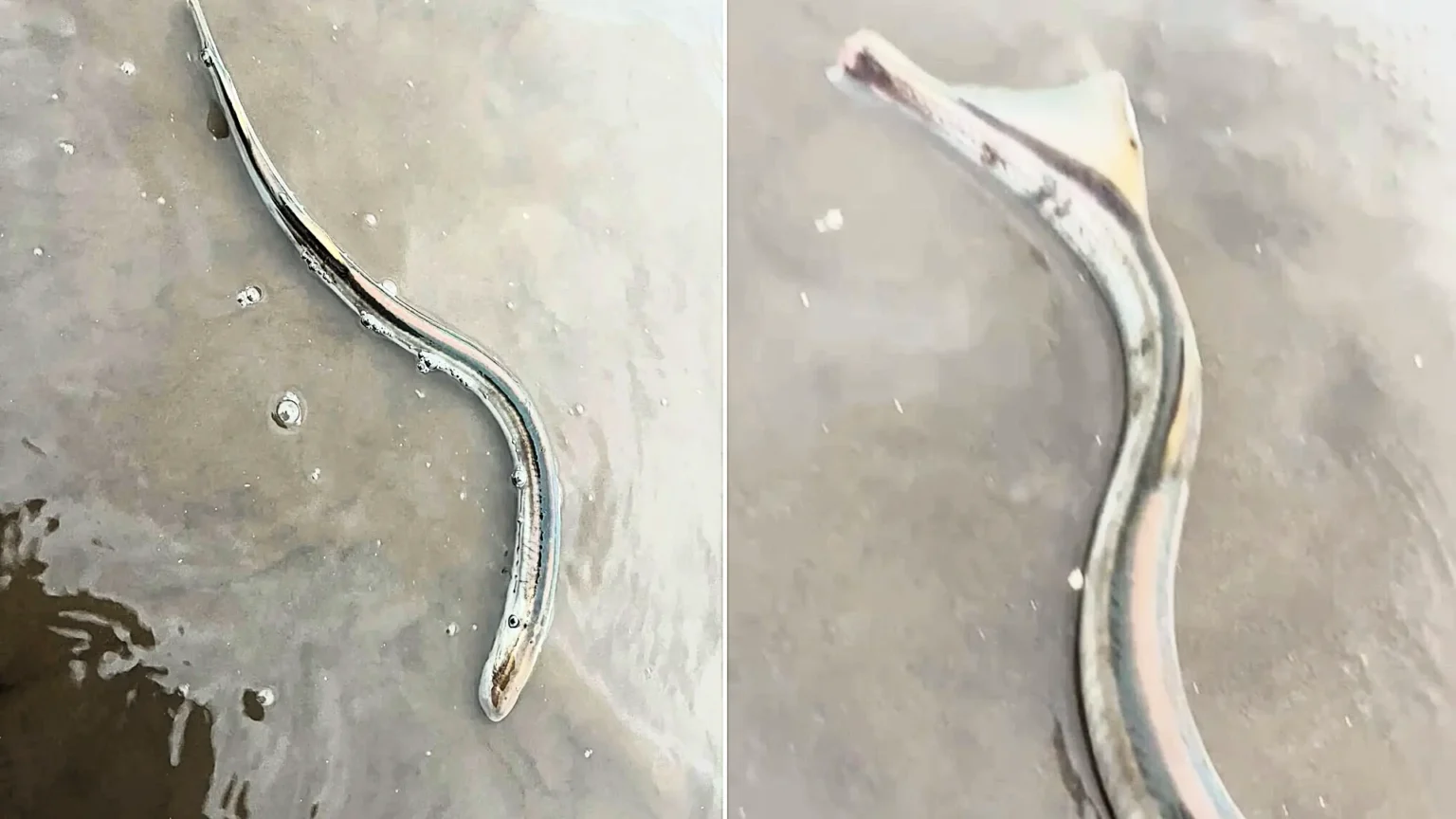


A teenager has found a rare ‘prehistoric vampire fish’ at his local beach.
Diego Sebastián Alfonso, 15, was strolling along the shoreline with his parents when he came across the bizarre creature washed up on the sand.
He filmed the blood-sucking fish before gently returning it to deeper water.
READ MORE: Terrifying moment 3.5m ‘great white’ swims within ONE METRE of bodyboarder
The eel-like animal then swam away under its own power.
The fish was a rare sea lamprey known as Geotria macrostoma – dubbed the ‘vampire of the sea’ for its jawless, funnel-shaped mouth lined with teeth.
The lamprey also has a piston-like tongue that latches onto larger marine animals to suck their blood.
It was found at the main beach in Berisso near Buenos Aires, Argentina, on 18 June.
Experts recently honoured Diego with a special ceremony, praising his actions as a vital scientific contribution.
Scientists described the creature as a “living fossil”.
Its ancient lineage predates the dinosaurs and has survived multiple mass extinctions.

Adults typically measure 40-60cm, although some can reach 80cm.
Researchers from the National Scientific and Technical Research Council (CONICET) and the Raúl Ringuelet Limnology Institute confirmed the find as highly significant.
Only eight previous records exist for this species in the Río de la Plata estuary, dating from the late 19th century to 1950.
Biologist Darío Colautti, director at the Raúl Ringuelet Limnology Institute, called it “an important scientific discovery”.
He joined colleagues in presenting Diego with a diploma, a book on local fish species, and a voucher for fishing gear, as reported by Whats The Jam.
Specialist Carla Riva Rossi, who studies lampreys in Patagonia, described the sighting as “quite extraordinary”.
She believes the creature was likely carried north while attached to a whale, salmon or other large host.
Lampreys spend up to five years of their life as larvae buried in clean river sediment before migrating to the sea.
Their presence signals healthy, well-oxygenated waters free of heavy pollution.
Tomás Maiztegui of the fish laboratory said the video has opened doors for further studies: “I didn’t think these creatures were still in the Río de la Plata.”
Diego’s footage has given experts a rare glimpse of this elusive parasite in northern waters.
READ MORE: Dad offers earplugs to passengers and apologises for baby’s cries on night flight