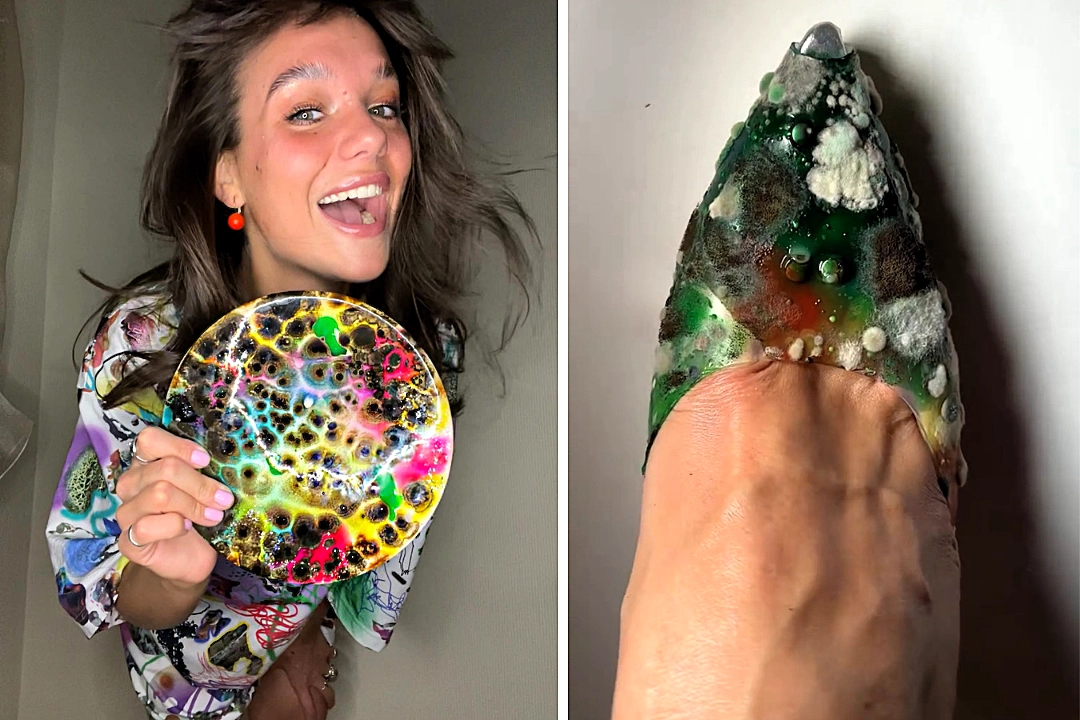

A bio-artist has revealed one of her most unusual creations – a pair of heels made from mould.
Dasha Plesen spends her days cultivating microorganisms and observing their growth, before turning the spores into bizarrely beautiful art.
The 29-year-old, who has over 310,000 followers, shares her colourful, fuzzy creations online, with fans “obsessed” – especially with one of her latest pieces.
READ MORE: Ariana Grande lookalike says people ‘scream’ at her in public
- Advertisement -
In a video, Dasha gently places her foot into an open-toed heel, fully covered in green and white mould, plus a few splashes of pink and red.
The content creator, known as the ‘Mold queen’ and who travels across the world to collect samples, first started experimenting with this medium when she was a student.
“When I entered art school instead of medical school, that fascination [with surgical atlases, medical instruments and the atmosphere where life is examined very closely] did not disappear,” she told What’s The Jam.

“It simply transformed into an artistic language.
“I began experimenting with biological materials and realized that microbial growth could form incredibly complex visual structures.
- Advertisement -
“At the microscopic level, mold and fungi create textures, colors, and spatial compositions that resemble landscapes, abstract paintings, or even cosmic imagery.”
Dasha’s process begins by “preparing a nutrient medium and setting the environmental conditions for cultivation”.
The Russian-born artist even works with human skin microbiome for some of her projects.
- Advertisement -
She said: “I can influence certain starting conditions such as color, temperature, or the composition of the medium, but the organisms themselves always remain co-authors of the work.
“Their growth depends on time, humidity, density of microorganisms, and many other factors.
“Because of this every piece develops its own form and cannot be reproduced exactly.
“My work can take many forms.
Sometimes it exists as petri dish compositions that resemble microscopic landscapes.
“Sometimes it becomes part of sculptural works or photographic documentation of living processes.”
Dasha knows that her art isn’t for everyone.
She said: “The reactions are usually very polarized.
‘Some people feel immediate fascination, while others experience strong rejection.
“Mold and bacteria are deeply associated with contamination and decay in everyday life, so it is natural that people react emotionally when they encounter them in an artistic context.
“For me, the beauty appears when you look beyond that first reaction.
“When someone calls my work disgusting, I understand that response.
“It reflects how we are culturally trained to react to microorganisms.
“But if a person looks a little longer, very often curiosity begins to replace rejection.
“That shift in perception is actually an important part of the work for me.”
Dasha’s heel video, which has over 7,500 likes, has been met with intense curiosity – and plenty of jokes – from fascinated viewers.
“Redefining ‘Foot Fungus’,” said one person.
“I love your work,” added someone else.
Another viewer said: “Ohmygod I need.”
“There’s so much to be said about this,” added Bel, without saying more.
“Fit for a Prin-cesspool,” joked someone else.
“This is why i love human beings this is sooo cool!!!,” added another fan.
“The last of us OF edition,” said another fan.
Will added: “YUCKY! I LOVE IT!!”
Despite some negative comments, Dasha, who has been a “bio-artist challenging beauty since 2015”, is so popular that she has a wait list.
She added: “Working with microorganisms constantly reminds me that life is deeply interconnected and that many important processes happen beyond the scale of our usual perception.
“We live surrounded by invisible ecosystems that shape our environment, our bodies, and even our relationships with other people.
“Through my work I try to make this invisible world visible and invite viewers to reconsider their relationship with it.
“Sometimes what initially seems disturbing can also reveal unexpected beauty and meaning when we allow ourselves to look more closely.”