

For over 30 years, Banksy has been the world’s most successful secret. The Bristol street artist responsible for some of the most recognisable and politically charged artworks on the planet has managed to operate in near-total anonymity — in public, in cities across the world, often in broad daylight — without ever being publicly identified. Until today.
On Sunday, Reuters published a 7,000-word investigation that claims to have identified Banksy ‘beyond dispute’ as Robin Gunningham, a 52-year-old man born in Bristol in 1973. Gunningham later changed his name legally to David Jones — and the story of how Reuters found that out is quite something.
Who is Robin Gunningham?
Gunningham grew up in Bristol — the same city where Banksy’s earliest work appeared in the late 1980s and early 1990s. He was part of the Bristol underground art scene that produced several significant artists, and his name had circulated in whispered conversations among street art researchers for years.
In 2008, the Mail on Sunday published a story naming Gunningham as Banksy. The story was largely dismissed or ignored at the time, and no one could prove it conclusively. What happened next, according to Reuters, is remarkable: Gunningham’s then-manager Steve Lazarides quietly arranged for him to legally change his name to David Jones — one of the most common names in the UK — effectively hiding him in plain sight.
David Jones. There are approximately 6,000 men with that name in the UK. It was, by any measure, an extremely good move.
The evidence: how Reuters cracked it
| # | Evidence | Detail |
| 1 | The New York arrest | In September 2000, a man was arrested at 4:20am on the roof of 675 Hudson Street in New York for defacing a Marc Jacobs billboard. He hand-signed a police confession with his real name: Robin Gunningham. The document sat in a New York court archive for 25 years. |
| 2 | The Ukraine connection | In late 2022, Banksy painted murals on bombed-out buildings outside Kyiv. Reuters matched immigration records and found ‘David Jones’ (with Gunningham’s exact birthdate) crossed the Ukrainian border on the same day as Robert Del Naja of Massive Attack. |
| 3 | The name change trail | By cross-referencing Ukrainian border records with known dates when Del Naja was in the country, Reuters was able to identify the ‘David Jones’ travelling with him — and match the birthdate back to Gunningham. |
The Massive Attack connection
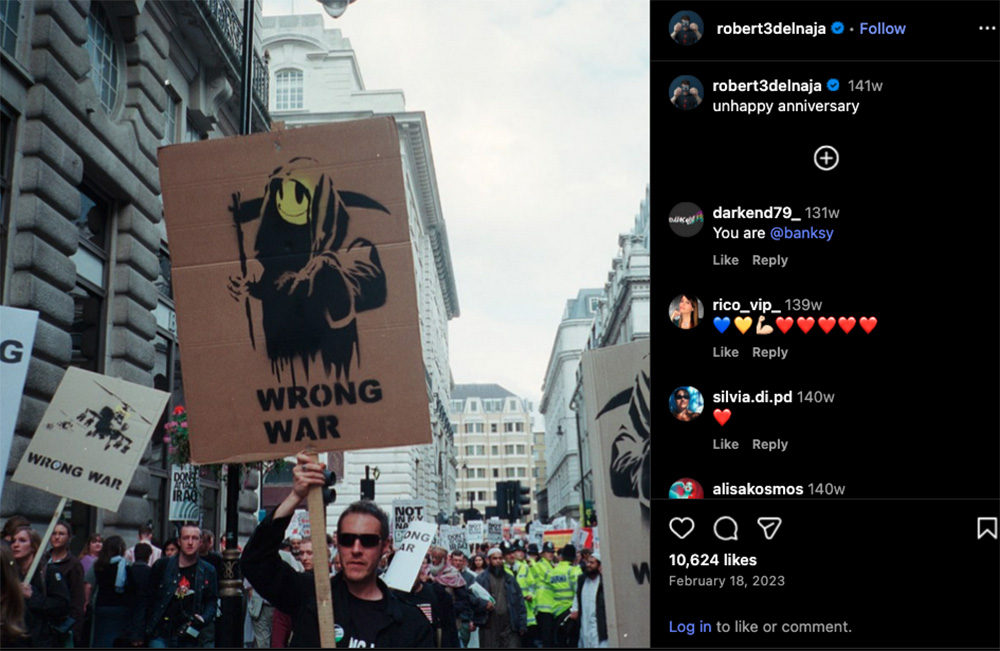
Robert Del Naja, co-founder of Bristol band Massive Attack, has been quietly associated with Banksy for years in art world circles. Reuters’ investigation puts him squarely in the frame again — not as Banksy, but as a close collaborator who has been present at several major pieces.
The two were reportedly in Ukraine together in October 2022, part of a small group who drove into the country and painted murals on buildings that had been destroyed in Russian attacks. Banksy later confirmed the Ukraine works were his on Instagram. Del Naja’s presence on that trip is described in the Reuters investigation as one of the key threads that ultimately led them to Gunningham.
What Banksy says
| Banksy has decided to say nothing. — Pest Control, Banksy’s authentication company, responding to the Reuters investigation |
His lawyer, Mark Stephens, wrote to Reuters before publication asking them not to run the story. He argued it would violate Gunningham’s privacy, interfere with his work, and ‘put him in danger’. He also said his client ‘does not accept that many of the details contained within your enquiry are correct’ — without specifying which details.
Reuters published anyway. The agency concluded that the public has a legitimate interest in understanding the identity of a figure who has had ‘profound and enduring influence on culture, the art industry and international political discourse’.
The debate: should Reuters have published?
Within hours of publication, the story split opinion sharply. Many Banksy fans felt the anonymity was part of the art — that unmasking him diminishes something meaningful. Others argued that a figure who has generated tens of millions of pounds in commercial art sales, and who regularly engages with global political events, cannot reasonably claim the same privacy as a private citizen.
The fact that he has successfully maintained anonymity for this long — operating in cities around the world, being photographed multiple times in proximity to his own murals, and evading identification despite the resources of global media organisations — is itself remarkable. Whether or not you think Reuters was right to name him, the story of how he pulled it off is extraordinary.
Who is Banksy — the quick version
Banksy began as a Bristol graffiti artist in the late 1980s, initially working freehand before switching to stencils for speed and precision. His work started appearing in London in the late 1990s and rapidly became internationally recognised. His pieces — a rat holding a placard, a child releasing a heart-shaped balloon, riot police with smiley faces — became some of the most reproduced images of the early 2000s.
His work at auction regularly sells for millions. A piece called ‘Girl With Balloon’ famously self-destructed through a built-in shredder immediately after being sold for £1 million at Sotheby’s in 2018, in what became perhaps the most talked-about art event in recent history.
He has painted in Gaza, in New Orleans after Hurricane Katrina, on the West Bank separation wall, and in a bombed-out Ukrainian village. His identity was, until today, one of the most durable mysteries in popular culture.
Reuters’ full investigation into Banksy’s identity is available on reuters.com. Banksy’s work can be authenticated through Pest Control at pestcontroloffice.com.