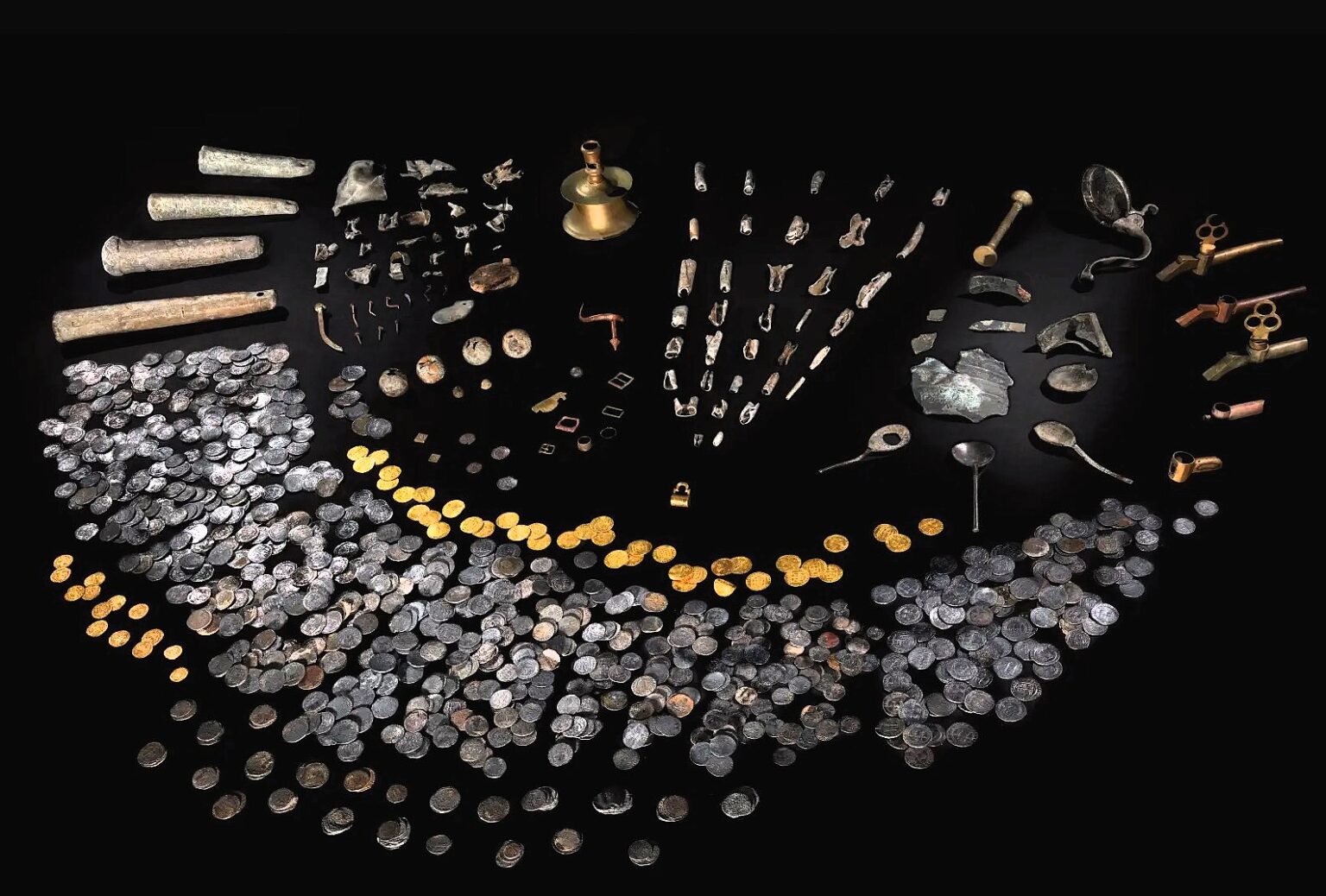
One of the artefacts found and on display at Amgueddfa Cymru, Wales' national museum. This image shows a close up of some of the collection. (Jam Press/Amgueddfa Cymru)
A hobby treasure hunter who spent more than two decades searching a beach with his metal detector was “overwhelmed” after uncovering a huge hoard of gold from a 16th century shipwreck.
Peter Hughes, 69, discovered hundreds of coins and artefacts after storms stripped away the sand concealing the wreck of the merchant vessel Ann Francis.
The treasure dates back to 1583, when the Ann Francis was blown off course during a ferocious storm while returning from Spain.
The ship’s owner, Francis Shaxton of Kings Lynn, had sent a valuable cargo of grain to Spain but lost both the vessel and its payment when it was wrecked on Margam Beach in Neath Port Talbot, as reported by What’s The Jam.
Peter said: “When I lifted the coin from the sand, and the sand fell off the coin, it glowed like the sun in my hand.
One of the artefacts found and on display at Amgueddfa Cymru, Wales’ national museum. This image shows a close up of some of the collection. (Jam Press/Amgueddfa Cymru)
“I was overwhelmed, because I saw the figure of a saint holding a ship, Saint Vincent, and I thought it was a token at first.
“But when I turned it over and saw the shield of Portugal, then I knew it was a coin.
“I was overwhelmed with excitement, the thrill was unbelievable.”
Peter said he had visited the beach more than 1,000 times and spent thousands of hours searching for the wreck.
Most trips ended with nothing being found. He said he was fortunate to have a high tolerance for disappointment and that the thrill of searching kept him going.
Among his discoveries are several historical gold coins from the reign of Ferdinand and Isabella of Spain, a Boatswain’s whistle and a combination lock from one of the ship’s wooden chests.
One of the artefacts found and on display at Amgueddfa Cymru, Wales’ national museum. This image shows The Portuguese São Vicente Gold Coin , named after the portrait of Saint Vincent of Saragossa, patron saint of cheerleaders and the city of Lisboa, on the reverse (tail) of this coin. It was minted in 1555-1557 during the reign of John the third. (Jam Press/Amgueddfa Cymru)
The lock’s secret word remains uncracked despite numerous attempts.
It is estimated that only a quarter of the money aboard the Ann Francis, which was wrecked on 28 December 1583, has ever been recovered.
The remarkable collection, which includes rare gold coins, has now gone on public display for the first time at the National Waterfront Museum.
Peter said he initially did not know what to do with the discoveries before contacting Amgueddfa Cymru, Wales’ national museum.
“The objects and the treasure belong to the people, and belonged to the heritage of Wales,” he added.
“The Pirates of the Caribbean come to mind when I look at it.”
One of the artefacts found and on display at Amgueddfa Cymru, Wales’ national museum. This image shows A Spanish eight reales coin , one of the famous pieces of eight, also known as a Spanish dollar. The majority of coins were minted in the name of Ferdinand and Isabella. They vary from 8 reales down to half a real , although the majority are 4 reales . The reverse of each of these coins shows the symbols of Aragon and Castille, a yoke to represent Aragon and a bundle of arrows to represent Castille. (Jam Press/Amgueddfa Cymru)
Alastair Willis, of Amgueddfa Cymru, said: “Not only are the coins and artefacts spectacular, but they are backed up by a wealth of contemporary records that bring together stories of sailors, looters, lords, a smuggler and even a woman accused of witchcraft.
“These stories and the collection are fascinating, and it is wonderful that Amgueddfa Cymru has the opportunity to display them.”
Nicole Deufel, of the National Waterfront Museum, said: “We are delighted to be presenting this fascinating hoard from the Ann Francis for public display for the first time.
One of the artefacts found and on display at Amgueddfa Cymru, Wales’ national museum. This image shows Spigots and taps, which would be hammered into beer or wine barrels. (Jam Press/Amgueddfa Cymru)
“As the National Waterfront Museum continues on its journey of redevelopment, bringing this wonderful collection of objects to the museum is a fitting addition to our displays as we move towards being focused on telling the stories of Wales and its connections and relationship with the sea.
“We can’t wait for visitors to find out more about this significant historical treasure that was discovered on Welsh shores.”
The stretch of Margam Beach where the treasure was discovered is now a protected site to preserve any remaining evidence of the shipwreck, making it illegal to search there.
One of the artefacts found and on display at Amgueddfa Cymru, Wales’ national museum. This image shows The Portuguese São Vicente Gold Coin , named after the portrait of Saint Vincent of Saragossa, patron saint of cheerleaders and the city of Lisboa, on the reverse (tail) of this coin. It was minted in 1555-1557 during the reign of John the third. (Jam Press/Amgueddfa Cymru)One of the artefacts found and on display at Amgueddfa Cymru, Wales’ national museum. This image shows A Spanish doble excelente gold coin that portrays Ferdinand and Isabella, the so-called Catholic Monarchs, who were responsible for the unification of Spain’s two largest states, Aragon and Castille, as well as sponsoring Christopher Columbus’ voyage to the New World. They reigned together from 1474 until Isabella died in 1504. Ferdinand’s reign lasted until 1516. Their coins were very successful and so we see that many of the coins engraved with the names of Ferdinand and Isabella were minted after the death of Ferdinand and Isabella. (Jam Press/Amgueddfa Cymru)One of the artefacts found and on display at Amgueddfa Cymru, Wales’ national museum. This image shows A Spanish doble excelente gold coin that portrays Ferdinand and Isabella, the so-called Catholic Monarchs, who were responsible for the unification of Spain’s two largest states, Aragon and Castille, as well as sponsoring Christopher Columbus’ voyage to the New World. They reigned together from 1474 until Isabella died in 1504. Ferdinand’s reign lasted until 1516. Their coins were very successful and so we see that many of the coins engraved with the names of Ferdinand and Isabella were minted after the death of Ferdinand and Isabella. (Jam Press/Amgueddfa Cymru)One of the artefacts found and on display at Amgueddfa Cymru, Wales’ national museum. This image shows A Spanish eight reales coin , one of the famous pieces of eight, also known as a Spanish dollar. The majority of coins were minted in the name of Ferdinand and Isabella. They vary from 8 reales down to half a real , although the majority are 4 reales . The reverse of each of these coins shows the symbols of Aragon and Castille, a yoke to represent Aragon and a bundle of arrows to represent Castille. (Jam Press/Amgueddfa Cymru)One of the artefacts found and on display at Amgueddfa Cymru, Wales’ national museum. This image shows Thaler of Meurig Elector of Saxony. This is one of a variety of thalers that were minted in the German states and counties of the Holy Roman Empire in the middle of the 16th century, which have been found on the beach. Their name evolved into dollar, which became shorthand for all coins of that size including the Spanish eight piece. (Jam Press/Amgueddfa Cymru)One of the artefacts found and on display at Amgueddfa Cymru, Wales’ national museum. This image shows Cannonballs with cube-shaped holes in them, suggesting that they probably used die-shaped balls. Each ball held an iron blade, it is possible that the intention was to cause more damage or enable the weapon to spin. (Jam Press/Amgueddfa Cymru)One of the artefacts found and on display at Amgueddfa Cymru, Wales’ national museum. This image shows one of two weights for coins, which would be used to check the weight of gold coins from the reign of Henry the fourth, which were still in international circulation. It would be important for traders to have a variety of these weights in order to be able to check the different types of international currency that would be used to pay them. (Jam Press/Amgueddfa Cymru)One of the artefacts found and on display at Amgueddfa Cymru, Wales’ national museum. This image shows a boatmaster’s or bosn’s whistle. It would be used to give orders on board the ship – its sound could be heard above the sound of the sea. (Jam Press/Amgueddfa Cymru)One of the artefacts found and on display at Amgueddfa Cymru, Wales’ national museum. This image shows a Brass candlestick. (Jam Press/Amgueddfa Cymru)One of the artefacts found and on display at Amgueddfa Cymru, Wales’ national museum. This image shows a Pewter tankard handle and lid. (Jam Press/Amgueddfa Cymru)One of the artefacts found and on display at Amgueddfa Cymru, Wales’ national museum. This image shows A sixpence piece of silver portraying Elizabeth the First, dating from 1580. One of the robbers may have dropped this or it may be a pocket brass that belonged to one of the crew. It is possible that the silver and copper coins of other small denominations in Spain, Portugal and Germany that were found on the beach had been collected in ports on the continent as small change. (Jam Press/Amgueddfa Cymru)One of the artefacts found and on display at Amgueddfa Cymru, Wales’ national museum. This image shows Measuring compasses, which would be used with charts to determine the location of the ship based on a known starting point, a process of estimation now known as ‘dead reckoning’. (Jam Press/Amgueddfa Cymru)