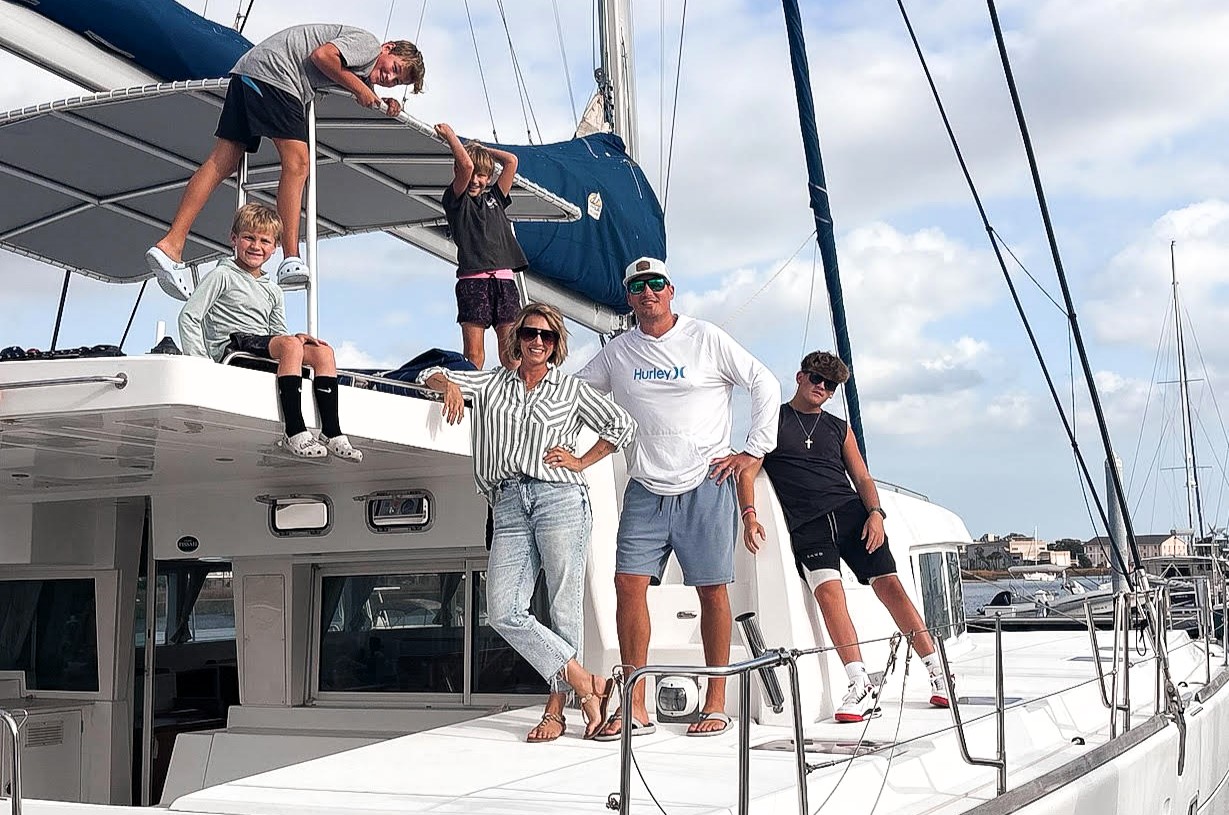


A couple have shared how they sold their expensive house to live on a boat with their four kids and save thousands a month.
Justin and Jen Wisdom, both 40, took the drastic step after getting fed up with the daily grind.
Teacher Justin and interior designer Jen took the plunge by buying a catamaran with their four sons, Liam, 14, Langston, 13, Tavner, 11, and Tenneson, six.
READ MORE: Thrilled bargain hunter nabs £300 designer dress for a FIVER
Despite being labelled “insane”, they haven’t looked back and have cut their annual bills by 75%.
“After almost 20 years in the same city, four kids, multiple jobs, and more moves from suburb to suburb than we can count, Justin came home one day with this wild idea, ‘What if we bought a catamaran and sailed the world?’,” Jen told Whats The Jam.
“I honestly thought he’d lost his mind.


“We had never sailed before, nor did we know a single person who had.
“But then we started watching YouTube videos of other families doing exactly that, living slower, simpler, more connected lives on the water.
“Little by little, what felt impossible started to feel intriguing.
“I could see the spark in Justin, and eventually I felt it in myself too.
“It was the first time in a long time we were completely on the same page, dreaming the same dream, and actually believing it might be possible.
“We sold everything, truly everything, except a few clothes, tools, and the essentials we knew would help us transition into boat life.
“In a strange way, it felt incredibly freeing.


“Over the years, we had accumulated this huge, mindless collection of stuff without even realising it.
“Letting it all go felt like hitting a reset button – simplify, start from scratch, breathe again.
“We loved our home and the little piece of land we had, but we didn’t love the life we were living in it.”
The parents started their journey with a bit of training, with a fellow family on Instagram offering hands-on sailing and live-aboard training experiences.
They flew from their home in Dallas, US, to Grenada to spend 10 days aboard their boat, learning everything they could about cruising life.
She added: “In our family, everything is a family decision.
“So before anything was set in motion, we all sat down together and had some long, honest conversations about what this kind of life might look like for us.
“We wanted the boys to feel part of the dream, not passengers on it.
“To our surprise, they were all immediately on board.


“Their excitement made the whole thing feel even more possible, like this wasn’t just our adventure, but something we were choosing as a team.
“What was hard, though, was leaving behind our two mini Aussie dogs and our cat.
“They’re now living their best lives with Justin’s parents, and we still get updates and videos from time to time, which helps.”
The response to their plan was mixed.
Jen said: “We got just about every reaction you can imagine.
“Some family and friends were genuinely excited for us, cheering us on, rooting for us, and wanting updates on every step.
“Others were completely confused about why anyone would choose this kind of life.
“There were people who were happy for us, people who were sad, and a few who thought we were absolutely insane.


“It was a mix of support, concern, curiosity, and disbelief.
“But at the end of the day, this was our story, not anyone else’s.
“Living on a catamaran isn’t as wildly different from living in a house as people imagine.
“We still have plenty of modern comforts, a microwave, air fryer, washing machine, stove, showers, a TV, and even video games.
“Daily life still has a rhythm, just with a much better view.
“Of course, there are some shifts.
“We wash dishes by hand.
“We hang our laundry outside to dry in the sun.


“When we’re not near land, we have to get creative about moving our bodies, stretching on deck, swimming, or turning chores into workouts.
“And when we’re on anchor, we take the dinghy into the nearest town to provision for food and supplies, which has become its own little adventure.”
Justin works remotely from the boat and the children are home-schooled for a few hours each morning – before the real fun begins.
She said: “Work and school still happen, just in a different setting.
“We follow the Texas Homeschool Coalition and keep our focus on the core subjects, reading, grammar, writing, math, and good citizenship.
“Believe it or not, it only takes us an hour or two a day.


“We use a mix of workbooks, novels, and computer‑based learning, depending on where we are and what the day looks like.
“Some days are cut short because we’re underway – nausea can kick in fast during a passage.
“Other days the learning is completely hands‑on and rooted in real life: how to sail, how to navigate, how to cook, how to explore new places with curiosity and respect.
“The boat has become its own classroom and the world outside our windows is the curriculum.
“One of the boys’ favourite features is the set of nets at the front of the boat, which they call the trampolines.
“They spend hours out there jumping, lounging, and turning it into their own floating playground.
“It’s simple, intentional living — just with a little more saltwater and a lot more sky.”


Jen added that although life at sea is idyllic, it does have ups and downs.
She said: “One of the biggest adjustments has been learning how quickly humidity sneaks into the boat.
“We also make our own water with a watermaker, so we’re always mindful of how much we use.
“The same goes for power, our energy comes from solar panels and lithium batteries, which means we keep an eye on usage throughout the day.
“Even showers have to be quick, since we can only heat so much water at a time.
“Rough seas can be very scary, too.
“The boat is built for that kind of motion but the sounds and the way everything moves are still something we’re getting used to.
“Fog is another one – suddenly losing visibility and feeling like you’re sailing inside a cloud.


“Overnight passages can be unnerving too.
“You can’t see anything beyond the boat, so you’re relying completely on GPS navigation to guide you safely through the dark.
“It’s a strange mix of trust, focus, and surrender.”
But the move has been financially and emotionally beneficial.
Jen said: “Out here on the water, we actually have very few bills.
“The biggest financial consideration is setting aside larger sums for repairs, because when something breaks on a sailboat – and it will – it’s never cheap.
“Our monthly fixed bills are over 75% less now.
“It’s so incredibly freeing.


“Before, we were lucky if we got to save a few hundred dollars per month.
“Now we save a few thousand per month.
“You have choices along the way where you can choose how much you’re spending as well.
“For example, anchoring offshore is free, whereas paying to moor in a marina costs money, and cooking on the boat is cheaper than eating out at restaurants.”
Jen admitted she was looking forward to further sailing adventures.
She added: “We still have many nautical miles ahead of us and so many countries left to explore, but this life has already given us more than we imagined.
“Of course, there are hard days no matter what your life looks like.
“With a cruising lifestyle, the lows can feel low but the highs are even higher.
“The moments of freedom, connection, and pure wonder make every challenge worth it.”