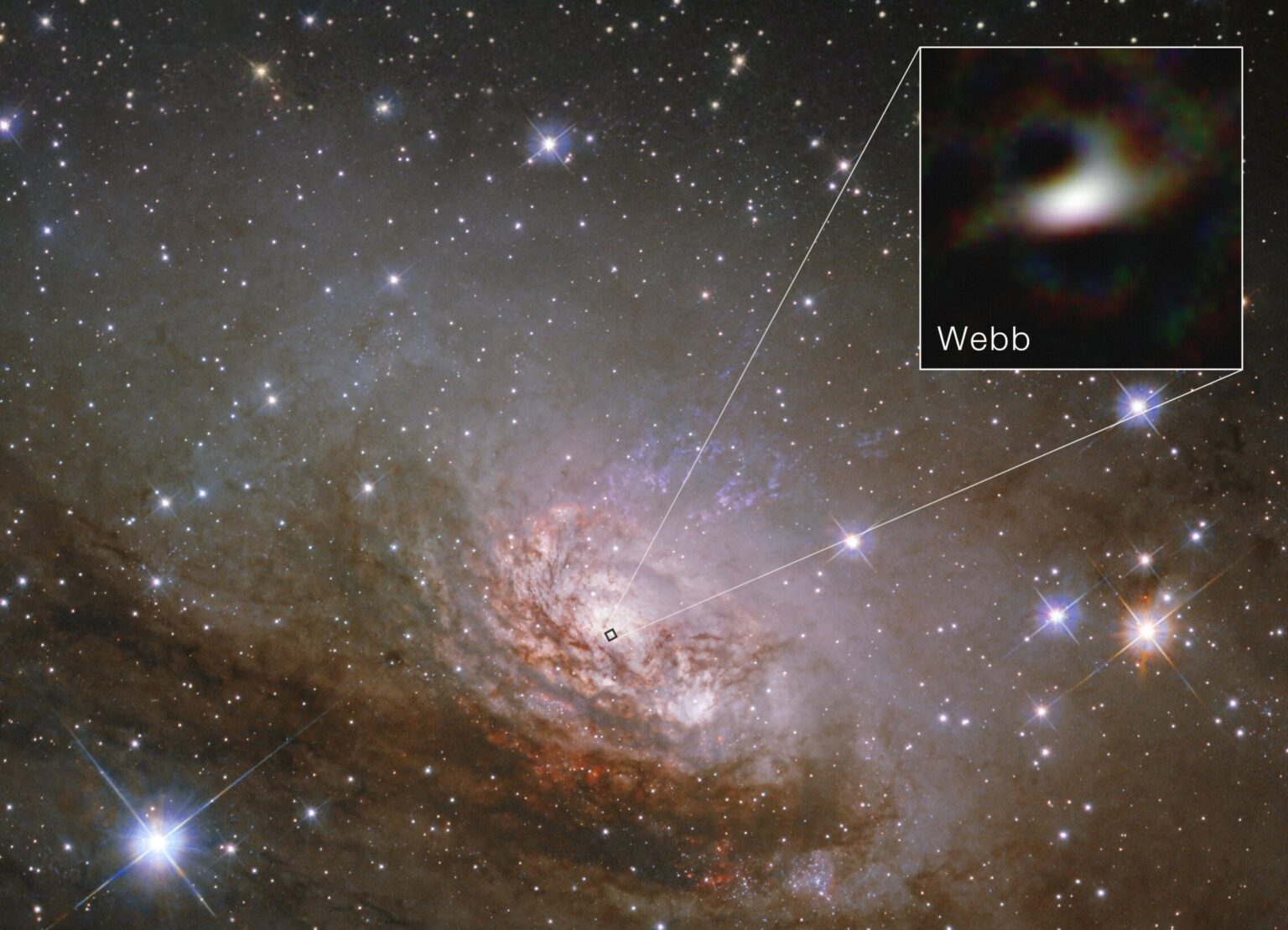


Scientists have shared an unprecedented, detailed view into the heart of a nearby galaxy – highlighting the extreme environment around a supermassive black hole.
The dramatic images were captured by NASA’s James Webb Space Telescope, which is travelling in space on a halo orbit after being sent up by rocket in 2021.
It has successfully peered deep into the centre of the Circinus Galaxy, located around 13 million light-years from Earth.
READ MORE: Science-fiction becomes a reality as new ‘exoskeleton’ is set to improve mobility
For the first time, astronomers can see the thick ring of gas and dust swirling around the galaxy’s supermassive black hole – a region that was previously hidden from view – in beautiful detail.
Webb’s powerful infrared vision can cut through cosmic dust, and revealed the black hole feeding on surrounding gas and debris, as reported by What’s The Jam.
The breakthrough offers new insights in our understanding of space.
NASA said: “Supermassive black holes like those in Circinus remain active by consuming surrounding matter.

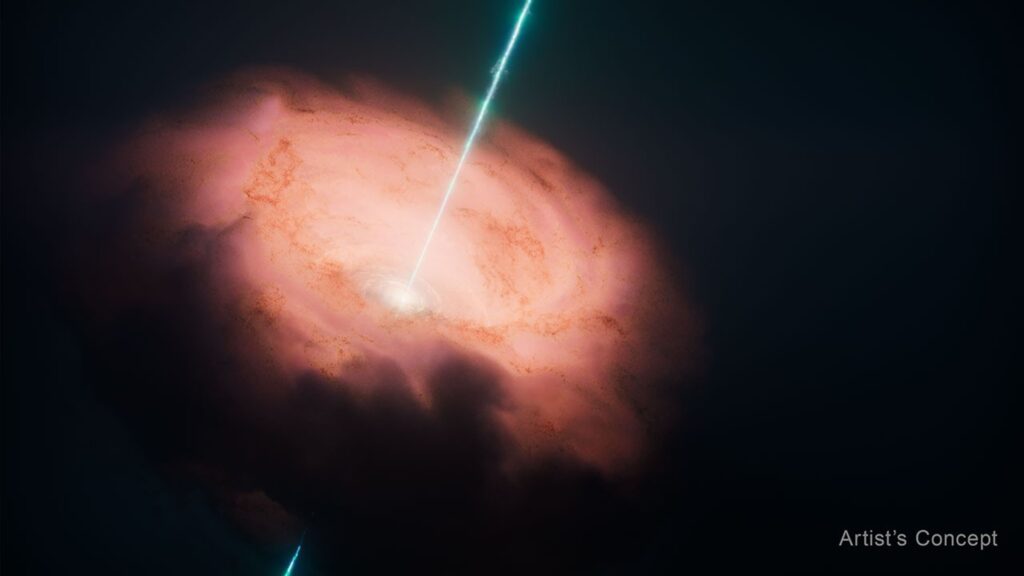
“Infalling gas and dust accumulates into a doughnnut-shaped ring around the black hole, known as a torus.
“As supermassive black holes gather matter from the torus’s inner walls, they form an accretion disk, similar to a whirlpool of water swirling around a drain.
“This disk grows hotter through friction, eventually becoming hot enough to emit light.”
NASA scientists say the images challenge long-held ideas about how light and energy escape from the middle of active galaxies.
They have also shed new light on star-forming regions packed tightly around the galaxy’s core, offering fresh insight into how black holes shape their surroundings.

The breakthrough will help astronomers better understand how supermassive black holes grow, and how they influence the evolution of galaxies across the universe, NASA added.
The Circinus Galaxy is one of the closest of its kind to Earth, making it an ideal target for Webb’s high-resolution instruments.
The astonishing pictures were released alongside shots from the Hubble Space Telescope – looking fuzzy by comparison – highlighting just how much more detail it can reveal.
In the latest images, swirling clouds of dust glow in fiery reds and oranges, wrapping around the galaxy’s core, the home of the ever-hungry supermassive black hole.
The images offer the clearest look yet at the heart of a nearby galaxy – and with the Webb telescope only just getting started, even more cosmic secrets are yet to be revealed.